

.png)

Shyness can feel like a quiet shadow that follows you everywhere — in social gatherings, at work meetings, or even during casual conversations. If you've found yourself holding back, avoiding eye contact, or worrying too much about what others might think, you’re not alone.
Millions of people experience shyness at some point in their lives. The good news? It’s possible to work through it and become more confident without pretending to be someone you’re not. This warm, conversational guide will show you practical ways to overcome shyness while staying true to yourself.
Understanding Shyness
Shyness isn't simply being introverted. While introversion is about preferring quiet and solitude, shyness often involves anxiety or self-consciousness in social situations.
It can manifest differently:
- Physical signs like blushing, sweating, or trembling
- Mental signs like overthinking, self-doubt, or replaying conversations in your head
- Behavioural signs like avoiding group activities or hesitating to speak up
Why We Develop Shyness
Shyness can stem from:
- Childhood experiences such as overly critical parenting or bullying
- Personality traits are inherited genetically
- Situational factors like new environments or high-pressure scenarios
- Past social failures that make you overly cautious
How to Overcome Shyness: The Roadmap to Authentic Confidence
Understanding shyness is your first leverage point. Shyness is often that internal voice whispering, “what will they think?” or the nervous feeling before joining a new group or starting a conversation. But beneath it is usually a wish to connect — and that’s something you can nurture rather than fear.
Start With Self-Awareness
Notice what happens in your mind and body when you feel shy. Do you replay worries about how others see you? Anticipate embarrassment? Recognising these triggers is step one. Research suggests that identifying and journaling your shyness moments helps build awareness and patterns, which is a proven CBT strategy for reducing social anxiety.
Journaling Your Shyness Moments
- Where were you?
- Who was with you?
- What did you feel physically (sweaty palms, blushing, shaky voice)?
- What thoughts ran through your mind?
Do this over several days. You’ll spot patterns — maybe you’re most anxious in big groups, or only when meeting authority figures. This awareness allows you to target your growth where it matters most.
Practice Gentle, Gradual Exposure
Social confidence is built in layers, not leaps. Gradual exposure (often called the “fear ladder” or exposure ladder) reduces anxiety over time, especially when paired with relaxation or mindfulness techniques. You create a step-by-step plan to face fear, starting with the least threatening activity.
Start at the bottom. Once a step feels manageable, move up. You’ll notice anxiety ratings start to drop as you practice — this is basic exposure therapy at work.
Example of a Social Exposure Ladder
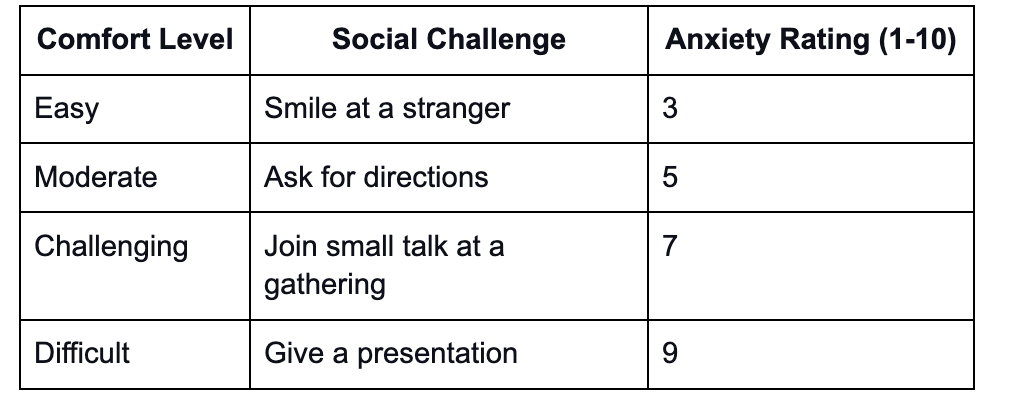
Ladder Technique in Steps
- Engage in small talk with a cashier or neighbour.
- Join online discussions or comment on a post.
- Attend a small, familiar event.
- Speak up in a group where you feel safe.
- Volunteer for a speaking opportunity at school or work.
Practice makes progress — not perfection.
Build Your Inner Dialogue: Self-Compassion Over Criticism
Your inner “self-talk” shapes your experience. Shy people often have an overly critical internal narrator (“I’ll look silly,” “I’m terrible at this.”) Step back and replace this voice with something more compassionate. CBT calls this “cognitive restructuring.” Challenge those thoughts, then gently reframe them.
From Self-Criticism to Self-Compassion
- Instead of: “Everyone will notice if I mess up.”
- Try: “Most people are worried about themselves.”
- Instead of: “What if I sound stupid?”
- Try: “It’s okay to make mistakes — that’s how I learn.”
Positive affirmations can reinforce these new patterns (“I am worthy of connection,” “My voice matters,” “Every attempt builds my confidence.”)
Confidence-Boosting Practices for Shy Situations
Harness the Power of Preparation
Preparation eases nerves before social events. Plan a few talking points, questions, or compliments to use as conversation starters.
Simple Conversation Starters
- “How’s your day going?”
- “I love the playlist here. Do you know the artist?”
- Comment on a shared environment: “This space has such a calm vibe, don’t you think?”
Rehearsal helps: Practice your openers in front of a mirror or with a supportive friend.
Practice Non-Verbal Skills
Body language sends powerful social signals before you say a word. Confident body language includes gentle eye contact, relaxed posture, and a genuine smile. Even if you don’t feel confident at first, acting “as if” with your body can help your mind catch up.
Try:
- Standing with shoulders relaxed
- Uncrossing your arms to look more open
- Smiling when greeting people
- Looking at the bridge of someone’s nose, if direct eye contact feels overwhelming
Reframe Social Anxiety in the Moment
The anxious mind loves worst-case scenarios (“I’ll freeze up,” or “Everyone will see I’m nervous”). Cognitive reframing invites you to challenge these assumptions. Instead, try the “curious over critical” approach — ask questions and really listen, making the focus about the other person rather than your own nerves.

In-the-moment tip:
If anxiety spikes, practice mindfulness:
- Name 5 things you can see
- Name 4 things you can touch
- Name 3 things you hear
- Name 2 things you can smell
- Name 1 thing you can taste
- This brings you back to the present and calms your mind.
Adopt Physical and Mental Techniques
Breathing Exercises for Calm
The 4-7-8 technique works wonders:
- Breathe in for 4 counts, hold for 7, exhale for 8. Repeat 3-4 times. This activates your body’s relaxation system.
Progressive Muscle Relaxation (PMR)
- Tense each muscle group for five seconds, then release
- Move from your toes up to your head
- Research shows PMR effectively lowers social anxiety symptoms and boosts calm.
Visualization
Before your next social event, close your eyes and picture yourself relaxed and confident. Imagine the sensations: smiling, making eye contact, having conversations — and even how you’ll feel afterwards. Visualisation is a proven way to reinforce self-belief and soothe nerves.
Develop Social Skills Systematically
Social skills aren’t an innate gift — they’re built through repetition and curiosity. Try these:
- Active Listening: Focus on the speaker, not your own responses
- Assertiveness Training: Express needs and opinions honestly, not aggressively
- Practice Humour: Light self-deprecating jokes can break the ice and show relatability
- Join interest-based groups, clubs, or classes: These provide low-pressure spaces to practice small talk around shared interests and gradually build conversational ease.
Create Accountability and Track Progress
Share your goals with a trusted friend or therapist who will encourage you, celebrate small wins, and provide honest feedback. Progress isn’t linear—some days you’ll soar, others you’ll stumble. Keep going. Every attempt counts.
Digital Age: New Challenges, New Tools
While social media can sometimes worsen comparison anxiety, technology also creates safer spaces to practice conversations. Try video calls, join online communities, or use apps designed for building confidence and communication skills. These "halfway" steps provide exposure without the full pressure of in-person interactions.
When Shyness Runs Deep
Some people’s shyness is deeply rooted and may cause intense avoidance or distress. In such cases, personal strategies might not be enough.
1. Shyness May Signal Social Anxiety Disorder
- When shyness causes intense distress or avoidance, it may indicate social anxiety disorder, a recognised mental health condition that is much more severe than normal shyness.
2. Symptoms and Impact
- Severe shyness can cause physiological symptoms like sweating, blushing, a racing heart, or stomach upset.
3. Professional Diagnosis Is Vital
- If social fears disrupt life, a mental health professional can diagnose social anxiety using interviews and standardised criteria, distinguishing it from mild shyness. It may severely interfere with work, relationships, education, and general day-to-day functioning.
Seeking Professional Help
A therapist, counsellor, or coach can help by:
- Identifying the underlying causes of your shyness
- Guiding you through cognitive-behavioural techniques
- Creating a personalised plan for exposure to social scenarios
Accepting Yourself in the Process
Overcoming shyness isn’t about erasing it completely — it’s about learning to live comfortably with your personality while expanding your comfort zones. Celebrate small wins. Smiling at a stranger, speaking up once in a meeting, or introducing yourself to a neighbour are all moments worth acknowledging.
Final Thoughts
Shyness doesn’t define you. It’s simply one part of who you are, and it can be gently reshaped with awareness, practice, and compassion. Whether it’s through journaling, learning better body language, or joining a small community group, every step you take to overcome shyness brings you closer to genuine confidence.
You don’t have to become the loudest person in the room. You just need to feel free enough to be yourself — and that, truly, is the most confident thing you can do.

.jpg)
.jpg)
.jpg)