
-p-500.png)
.png)

When it comes to mental and brain health, people often wonder: Should I visit a psychiatrist or a neurologist? The line between psychiatry and neurology can sometimes feel blurred — both deal with the same organ, the brain, yet approach it through different lenses. One studies the mind and its processes, while the other focuses on the neural circuitry that makes those processes possible.
In India, this distinction becomes especially important because many individuals first seek help from neurologists for issues like headaches, sleep disturbances, or unexplained fatigue — only to later discover psychological roots such as depression or anxiety (Sinha & Kaur, 2021). Understanding how psychiatry and neurology differ can help people make informed choices about their care and reduce stigma surrounding mental health consultations.
Understanding Psychiatry
Psychiatry is the branch of medicine that focuses on diagnosing, treating, and preventing mental, emotional, and behavioural conditions. Psychiatrists are medical doctors who use psychotherapy, medications, and lifestyle interventions to treat disorders like depression, anxiety, schizophrenia, bipolar disorder, and OCD.
Unlike psychologists, psychiatrists can prescribe medications such as antidepressants or mood stabilisers. They often focus on the subjective experience — how a person feels, thinks, and behaves — while balancing biological, psychological, and social factors in treatment (American Psychiatric Association, 2013).
In India, psychiatry is gaining more acceptance, especially with rising awareness of mental health concerns and digital therapy platforms like Rocket Health that make psychiatric help more accessible nationwide.
Understanding Neurology
Neurology, on the other hand, studies the nervous system — the brain, spinal cord, and nerves. Neurologists diagnose and treat disorders that arise from structural or functional abnormalities of the nervous system. Common neurological conditions include epilepsy, migraines, Parkinson’s disease, Alzheimer’s disease, multiple sclerosis, and stroke (Aminoff et al., 2021).
A neurologist’s approach is typically grounded in anatomy and physiology. For instance, while a psychiatrist might look at depression as a neurotransmitter imbalance or response to trauma, a neurologist might investigate whether brain lesions, seizures, or degenerative processes are at play.
Psychiatry vs Neurology: Core Differences
While both psychiatry and neurology share the brain as their primary focus, their approaches, tools, and goals diverge:
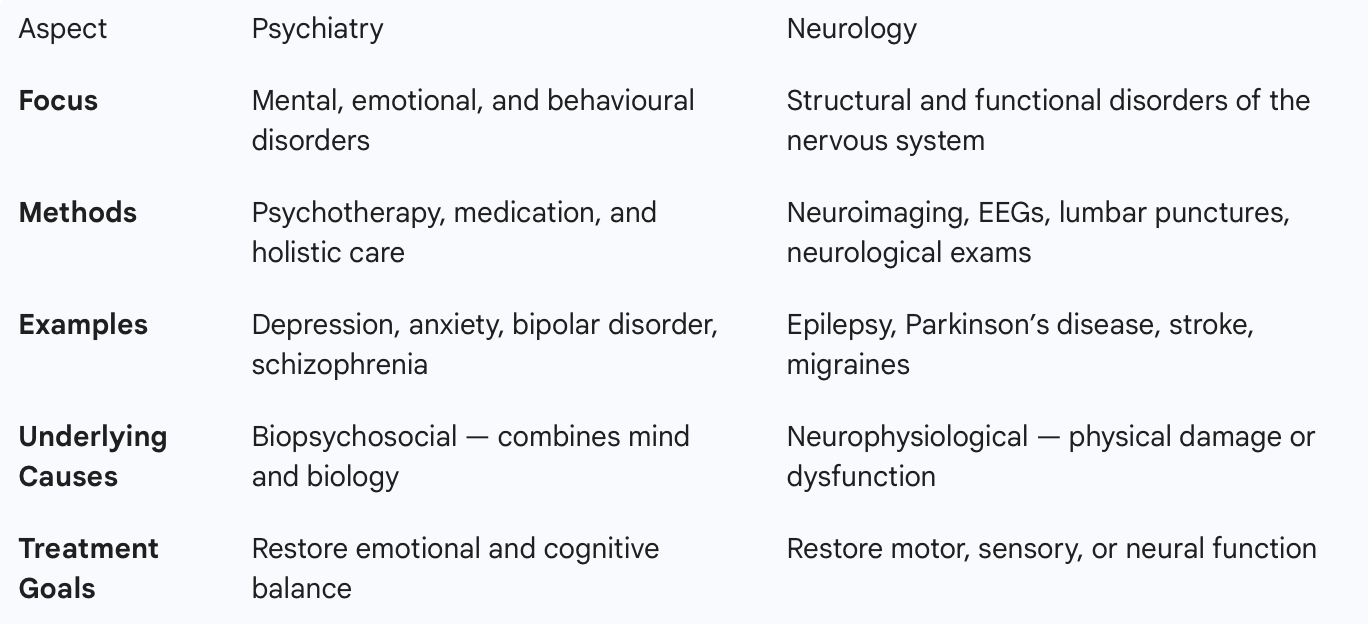
Despite these distinctions, overlaps often occur. Conditions like dementia, traumatic brain injury, or epilepsy can lead to psychiatric symptoms such as depression or psychosis. Similarly, chronic mental health disorders can alter brain structure and function over time (Müller et al., 2017).
Neurologist vs Psychiatrist for Depression
One of the most common points of confusion arises when deciding whether to see a neurologist or a psychiatrist for depression.
A psychiatrist is usually the right starting point for depression — especially when emotional symptoms such as sadness, hopelessness, or loss of interest dominate. They can provide psychotherapy, prescribe antidepressants, and monitor recovery.
However, a neurologist may be consulted if depression occurs with symptoms such as seizures, movement difficulties, chronic headaches, or after brain injuries or strokes (Rajkumar, 2020). Neurologists can rule out organic causes like neurodegenerative diseases or hormonal abnormalities before psychiatric treatment begins.
In some cases, both specialists collaborate — particularly in conditions like Parkinson’s disease or epilepsy, where depression is biologically linked to brain changes.
The Overlapping Zone: Neuropsychiatry
To bridge the gap between these two fields, neuropsychiatry has emerged as an interdisciplinary specialty that studies how brain dysfunctions manifest as psychiatric symptoms. This field integrates neurological testing with psychiatric evaluation to provide a holistic view of the brain–mind connection (Arciniegas & Anderson, 2021).
Neuropsychiatrists often treat conditions such as traumatic brain injury with personality changes, epilepsy with mood disorders, or dementia-related behavioural symptoms.
Can You Be Both a Neurologist and a Psychiatrist?
Yes — though rare, doctors can be trained in both fields. Dual specialisation allows clinicians to treat conditions that straddle the boundary between the physical and psychological. In India, a few teaching hospitals and academic institutions now encourage interdisciplinary research combining neurology, psychiatry, and psychology to improve patient outcomes.
Such training is particularly valuable in diagnosing complex cases — for instance, when neurological conditions mimic psychiatric ones, or when long-term mental health challenges affect brain structure and function.
Why Understanding Both Matters in India
In India, where conversations around mental health are still emerging, understanding the interplay between psychiatry and neurology can reduce misdiagnosis and stigma. Many people first consult neurologists for headaches, fatigue, or dizziness — physical symptoms that sometimes mask depression or anxiety (Kaur et al., 2022).
.jpg)
Integrating psychiatric screening into neurological assessments can lead to earlier detection of mood disorders. Likewise, psychiatrists who understand neurological signs can refer patients appropriately when cognitive or movement-related symptoms arise.
Rocket Health India is helping close this gap by connecting clients with both psychiatrists and therapists online — allowing holistic evaluation and treatment under one platform, accessible from any part of the country.
The Mind–Brain Connection: A Unified Perspective
While psychiatry and neurology may seem like two sides of the same coin, together they form a complete picture of human experience — the biological and the psychological. The human brain doesn’t separate thoughts from neurons; both coexist in a delicate balance.
As research continues to evolve, the boundaries between psychiatry and neurology are becoming increasingly blurred, paving the way for integrative models of care that address the brain and mind as one system.
Conclusion
Understanding the difference between psychiatry and neurology helps individuals seek the right kind of help at the right time. Whether it’s emotional distress or neurological symptoms, both fields play a crucial role in maintaining brain health. In India, the growing collaboration between psychiatrists, neurologists, and online healthcare platforms like Rocket Health is making it easier than ever to access complete, compassionate care.
If you’ve been wondering whether your symptoms are more neurological or psychological, don’t delay seeking help. Connect with Rocket Health India today for a confidential online consultation with experienced psychiatrists and mental health professionals.
References
American Psychiatric Association. (2013). Diagnostic and statistical manual of mental disorders (5th ed.). Washington, DC: Author.
Aminoff, M. J., Greenberg, D. A., & Simon, R. P. (2021). Clinical neurology (11th ed.). McGraw Hill.
Arciniegas, D. B., & Anderson, C. A. (2021). Neuropsychiatry: Towards a unified understanding of brain and mind. Journal of Neuropsychiatry and Clinical Neurosciences, 33(1), 1–8.
Kaur, S., Gupta, R., & Sinha, V. (2022). Stigma and barriers to mental health care in India: A review. Indian Journal of Psychiatry, 64(3), 230–238.
Müller, V. I., Cieslik, E. C., Laird, A. R., Fox, P. T., & Eickhoff, S. B. (2017). Ten simple rules for neuroimaging meta-analysis. Neuroscience and Biobehavioral Reviews, 84, 151–161.
Rajkumar, R. P. (2020). Depression in neurological disorders: The Indian context. Indian Journal of Psychological Medicine, 42(3), 207–214.
Sinha, V., & Kaur, S. (2021). Understanding overlapping symptoms in psychiatry and neurology. Asian Journal of Psychiatry, 65, 102–113.

.jpg)
.jpg)
.jpg)