
-p-500.png)
.png)

Have you ever spent three hours in the group chat dissecting a single text message for "hidden meanings"? For many of us, spotting a red flag has become a survival skill. But while we're busy playing detective with the bad stuff, we often walk right past the "green flags"—the quiet, steady signs that a relationship is actually healthy.
So, what are these overlooked green flags? They are the behaviors that suggest a partner is reliable, emotionally safe, and actually good for your long-term mental health—even if they don't feel like a high-stakes rom-com. Understanding these matters because "boring" consistency is often just another word for "peace."
What Are "Quiet" Green Flags?
Green flags are traits that indicate a person will be a positive, stable presence in your life. Most people ignore them because they aren't "flashy" or dramatic. Examples include:
- Consistency over intensity: They text back because they want to, not as a "game."
- Respecting a "No": They don't pout when you need a night alone.
- Active listening: They remember the random story you told about your third-grade teacher.
- Emotional regulation: They can be upset without making it your "job" to fix their mood.
Green Flags vs. Hollywood Myths
It's easy to confuse toxic intensity with "passion." Here is how to tell the difference:
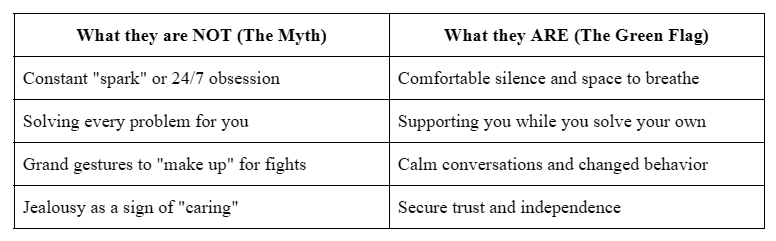
Common Signs and Symptoms of a Healthy Match
Healthy relationships affect your thoughts, emotions, and how you spend your Tuesdays.
Emotional Signs
- Feeling "leveled out" rather than constantly anxious.
- A sense of safety when sharing "bad" news.
- Lack of "performance anxiety" (you can be uncool around them).
Cognitive Signs
- Assuming the best of their intentions rather than jumping to conclusions.
- Being able to imagine a future without feeling a pit in your stomach.
- Feeling like your brain has "space" for other things besides the relationship.
Behavioural Signs
- Accountability: They say "I'm sorry, I messed up" without a "but" at the end.
- Life Outside the Bubble: They encourage you to see your friends.
- Predictability: You aren't constantly wondering "where you stand."
Why Do We Ignore Them?
Research suggests several reasons why we might overlook the "good ones."
Psychological Factors
- If you're used to chaos, "peace" can feel like "boredom."
- Negative core beliefs (e.g., "I don't deserve something easy").
- Cognitive biases that make us focus on threats rather than rewards.
Social and Environmental Factors
- Media influence that glorifies "the chase" and dramatic conflict.
- Past experiences with "breadcrumbing" that make stability feel foreign.
Impact on Daily Life
Living with a partner who shows these green flags changes your baseline.
- Work: You have more mental energy to focus because you aren't "detective-ing" your relationship.
- Self-Esteem: You feel liked for who you are, not just who you're "performing" to be.
- Growth: You feel safe enough to take risks in other areas of your life.
Frequently Asked Questions
Is "boring" always a green flag?
Not necessarily. There's a difference between "stable boring" (peaceful) and "disinterested boring" (no effort). A green flag is when the relationship feels easy, but the person is still clearly invested in you.
Can someone "learn" green flags?
Absolutely! Many people learn these behaviors through therapy and self-reflection. It's less about being a "perfect" person and more about having the willingness to be a healthy partner.
What if I miss the "drama"?
That's actually very common! If you're used to the highs and lows, stability can feel like a letdown at first. It takes time to recalibrate your brain to enjoy the "slow burn" of a healthy connection.
Conclusion
Green flags aren't about finding a perfect person; they are about finding a reliable one. They are the signs of a partner who handles the unglamorous parts of life with respect and consistency. When you stop looking for the fire, you finally have a chance to get warm.
If you find yourself constantly attracted to "chaos" or struggling to trust a healthy partner, you don't have to navigate it alone. Book a confidential consultation with Rocket Health today to explore your relationship patterns and build the secure, happy life you deserve.
References
- American Psychological Association. (2022). Building healthy relationships. https://www.apa.org
- Gottman, J. M., & Silver, N. (2015). The seven principles for making marriage work. Harmony.
- Mayo Clinic. (2024). Identifying positive relationship traits. https://www.mayoclinic.org
- National Health Service. (2023). Relationships and mental health. https://www.nhs.uk

.jpg)
.jpg)
.jpg)