
.png)
.png)
.jpg)
Integrative therapy (also called integrative psychotherapy or psychotherapy integration) is an approach that doesn’t bind the clinician to a single theoretical school. Instead, therapists combine ideas, techniques, and tools from different traditions (CBT, psychodynamic, humanistic, somatic, mindfulness-based, etc.) to form a tailored plan that fits the person in front of them. That tailoring can be guided by client preference, presenting problem, cultural context, and the best available research rather than allegiance to a single “brand” of therapy.
Core principles and common pathways
Although integrative clinicians vary, as studies show, most share these principles:
- Person-centered tailoring — treatment is adapted to the client’s needs, strengths, and values, not to a training manual.
- Multiple routes to change — integration recognizes that different methods (skill training, insight, relational repair, lifestyle change) can produce healing, and it uses whichever are indicated.
- Attention to relationship and context — integrative work emphasizes the therapeutic alliance, cultural fit, and client expectations as major drivers of outcomes.
- Evidence-informed flexibility — integrative therapists seek to use techniques with a solid evidence base while being open to combining approaches where appropriate.
Models of Integration: How Therapists Combine
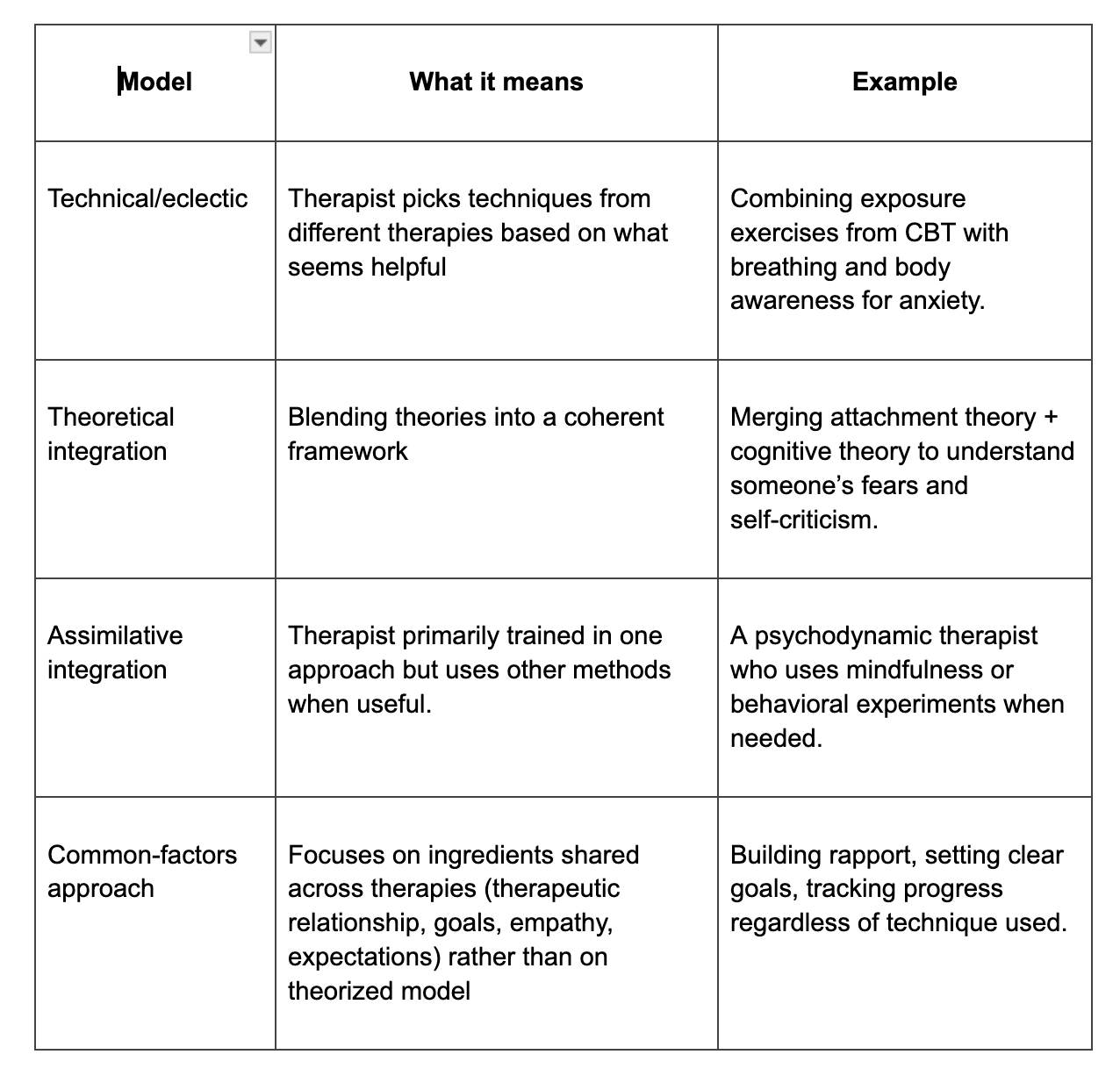
Therapists integrate in different ways. Here are common models:
Techniques you might see in integrative practice
Because integrative therapy is eclectic by design, sessions can look very different depending on client needs. Examples include:
- Skill-focused work from CBT (behavioral experiments, exposure, activity scheduling).
- Emotion- and relationship-focused interventions from psychodynamic or interpersonal therapies (exploring recurring patterns, attachment issues).
- Somatic or body-based techniques for regulation (grounding, breathwork).
- Mindfulness and acceptance-based practices for awareness and distress tolerance.
- Lifestyle/integrative elements (sleep, exercise, nutrition) when relevant to mood and anxiety problems
What does the research say?
A lot of studies show that well-delivered, evidence-based techniques (for example, CBT components) are effective for concerns like depression and anxiety, and integrative programs that combine behavioral, cognitive, relational and lifestyle elements can be similarly effective in real-world settings. Randomized trials of brief integrative interventions (e.g., “Personalized Integrative Therapy”) found outcomes comparable to brief CBT for depression and anxiety.
Beyond technique-level findings, an influential body of research emphasizes the common factors — therapeutic alliance, empathy, expectations, and cultural fit — as major contributors to outcome across therapies. That evidence supports integrative thinking because it suggests that tailoring treatment to strengthen those shared factors can be as important as choosing a single theoretical approach.
How online therapy expands integrative possibilities
Online and video-based therapy aren’t just convenient — they also enable many integrative practices in new, scalable ways:
- Access & continuity: video, chat, and hybrid formats reduce travel barriers and make it easier to maintain continuity of care (especially for busy people, those in remote areas, or during public-health disruptions). Meta-analytic evidence shows video-delivered psychotherapy produces large pre–post improvements and is generally non-inferior to in-person therapy for disorders such as depression, anxiety and PTSD — particularly for CBT-oriented work.
- Flexible, blended care: integrative programs often combine synchronous sessions (video) with asynchronous tools (workbooks, apps, text reminders) and brief digital skill modules — a design that fits stepped-care approaches and allows therapists to weave techniques like behavioral activation, mindfulness exercises, and tracking homework into everyday life.
- Measurement, personalization & data: digital platforms make it easier to collect routine outcome measures (PHQ-9, GAD-7) and tailor the blend of interventions in real time — e.g., increasing exposure work if anxiety scores stay high, or adding somatic regulation if sleep and arousal remain problems.
- Group and community formats: integrative care sometimes includes psychoeducation groups or lifestyle medicine sessions (exercise, sleep hygiene). Online delivery can scale these affordably while retaining therapist-led tailoring.
Practical tips: finding an integrative therapist (online or in person)
- Ask how the therapist decides what approach to use: an integrative therapist will describe a treatment plan that adapts to your goals rather than insisting on a single method.
- Check training and ongoing supervision: integrative work benefits from clinicians who are skilled in at least two solid approaches and who track outcomes.
- Look for outcome measurement and shared planning: good integrative therapists use questionnaires or progress reviews and adjust the plan when things don’t improve.
- For online care, check platform privacy, clinician licensure, and whether the service supports blended tools (handouts, brief modules, messaging between sessions).
Conclusion
Integrative therapy isn’t a grab-bag of techniques — it’s a deliberate, evidence-informed way to combine what works for the person sitting in front of you. It centers the therapeutic relationship and adapts method to need, and a growing research base supports both integrative programs and the use of online delivery when guided by clinicians. If you value flexibility, personalization, and practical skill-building, integrative therapy (especially when blended with digital supports) can be a powerful route to change.
Ready to try online integrative therapy?
If you want to explore personalized, clinician-led online therapy that supports integrative approaches, Rocket Health offers confidential mental-health services (therapy, psychiatry, and blended care options) that let you book and continue care from home. Book a session or learn more on Rocket Health’s mental-health page
References
Ephrem, F. Live psychotherapy by video versus in-person: A meta-analysis of efficacy and its relationship to types and targets of treatment.
Lopresti, A. L., Smith, S. J., Metse, A. P., Foster, T., & Drummond, P. D. (2020). The feasibility and efficacy of a brief integrative treatment for adults with depression and/or anxiety: a randomized controlled trial. Journal of evidence-based integrative medicine, 25, 2515690X20937997.
Norcross, J. C., & Goldfried, M. R. (Eds.). (2005). Handbook of psychotherapy integration. Oxford University Press.
Wampold, B. E. (2015). How important are the common factors in psychotherapy? An update. World psychiatry, 14(3), 270-277.
Zarbo, C., Tasca, G. A., Cattafi, F., & Compare, A. (2016). Integrative psychotherapy works. Frontiers in psychology, 6, 2021.

.jpg)
.jpg)
.jpg)